Table of contents
- What is voice cloning?
- How does voice cloning work?
- Can someone clone your voice without consent?
- Is it legal to clone your voice?
- When it’s illegal or risky
- When it’s legal
- Key laws & regulations
- Can a scammer use your voice?
- How to protect your voice from being misused?
- Conclusion
What is voice cloning?
Voice cloning uses artificial intelligence (AI) technology to create a copy of a person’s unique vocal patterns. It analyzes recordings of your speech to mimic your pitch, tone, and accent. The software will then be able to “read” any text it’s given in your voice, which raises serious concerns about identity theft and non-consensual deepfakes.
How does voice cloning work?
Voice cloning software uses machine learning algorithms to study the biometric data in your voice. During the training phase, the AI listens to audio samples to understand your intonations and breathing patterns.
While older technology required hours of audio, the new AI generators can create a very realistic clone from just a few seconds of speech.
Even worse, attackers often harvest these samples from public sources, where you’ve posted yourself talking. It could be social media videos, your voicemail, or even brief phone calls where they record you saying simple phrases.
Can someone clone your voice without consent?
Yes, not only is it entirely possible that someone can copy your voice without your permission (or knowledge), it’s also extremely easy.
If you have any audio of your voice online, like Instagram stories, TikToks, or YouTube videos, scammers can download it and feed it into cloning software. Because the technology is widely available and unregulated, scammers can use this software with almost no obstacles.
They don’t need you to agree to a recording. They only need access to a file that contains your voice. That’s why it’s so important to understand how scammers get your personal information.
Is it legal to clone your voice?
The legality of voice cloning is fairly complex because the laws are still catching up to new AI technologies, and it also varies a fair bit by location.
Generally, the act of cloning an individual’s voice is not illegal, but using that AI-generated voice to commit fraud, impersonation, or harassment is.
Most laws focus on the intent behind the use. If someone uses your voice for commercial gain or to deceive others without your permission, they’re likely breaking the law.
When it’s illegal or risky
Here are a few instances where using a cloned voice is almost always illegal, no matter where you are:
- Fraud and scams. Using a voice clone to trick someone into sending money or revealing sensitive data is wire fraud. This is often a key component of vishing (voice phishing) attacks.
- Commercial use. Using a celebrity’s or a private citizen’s voice to sell a product without permission violates their right of publicity and is illegal.
- Harassment. Creating audio deepfakes to bully, defame, or blackmail someone is illegal.
- Impersonation. Pretending to be someone else to gain unauthorized access to accounts creates a severe privacy breach.
When it’s legal
There are a few scenarios where voice cloning is lawful, though they can be ethically grey areas, so it’s worth being cautious if you aren’t using your own voice. Here are a few situations where it’s probably okay:
- Personal projects. Cloning your own voice for personal use is legal.
- Accessibility. Creating a voice model for someone who has lost their ability to speak (with their consent) is a legitimate medical application.
- Parody. In some jurisdictions, using a voice changer for obvious satire or parody is protected as free speech, provided it doesn't deceive the audience.
- Consent-based work. Voice actors often license their voices to companies for text-to-speech services under strict contracts.
Key laws & regulations
Few laws specifically target voice cloning by name yet, but governments are rapidly updating existing rules to cover AI. Here are three major, recent examples of laws that target the use of AI against people:
- The ELVIS Act (USA). In 2024, Tennessee became the first state to pass legislation protecting musicians and public figures from unauthorized voice cloning. It updates the relevant right of publicity laws to make it illegal to use AI to mimic someone’s voice without permission.
- The EU AI Act (Europe). This law requires that any content generated by AI, including cloned voices, must be clearly labeled. It aims to prevent deception by forcing companies to disclose when you are listening to a synthetic voice rather than a real human.
- California Civil Code. California recently updated its laws to protect against digital replicas. It makes it illegal to use AI to create a clone of a person’s voice or likeness for commercial purposes without their consent, even after they have passed away.
If you see someone trying to scam with cloned voices, you should report it to your local police station.
Can a scammer use your voice?
Yes, unfortunately. Scammers already use cloned voices to steal money and sensitive information. Because the technology is so convincing, it’s easy to trick a family member and even some security systems.
The most common example is known as the “grandparent scam”. A scammer calls your parents, grandparents, or spouse and pretends to be you. They use a cloned voice and claim they’re in an emergency and need money quickly. The panic, combined with hearing a familiar voice, tricks many people into falling victim.
Another dangerous development is the use of cloned voices to bypass authentication at banks and service providers. Sophisticated attackers use higher-quality voice clones to trick the automated systems, giving them access to your accounts.
In extreme cases, criminals even use voice clones to leave voicemails or make calls claiming they have been kidnapped. They play the cloned audio of “you” asking for help to extort a ransom from your loved ones.
How to protect your voice from being misused?
While you can’t erase your voice everywhere, you can make it much harder for scammers to find and use it against you. Here are a few practical steps you can take to reduce your risk:
- Establish a family safe word. Create a secret word that only you, close family, and friends know. If anyone calls claiming to be you, they need to provide the safe word. If they can’t, hang up immediately.
- Lock down your social media. Scammers scrape audio from social platforms. Set your accounts to private or, better yet, avoid posting anything scammers can use against you. Always be aware of AI spying on you online.
- Use two-factor authentication (2FA). Strong passwords and 2FA are much harder to fake than a voice print. Use these alongside your usual log-in methods (whether you use biometrics or not) to protect your accounts.
It’s also possible for scammers to record your voice using spyware and tracking apps. If you click an unsolicited link or download a suspicious app, it might take short recordings of your voice. The scammer can then use these to create a voice clone and target you.
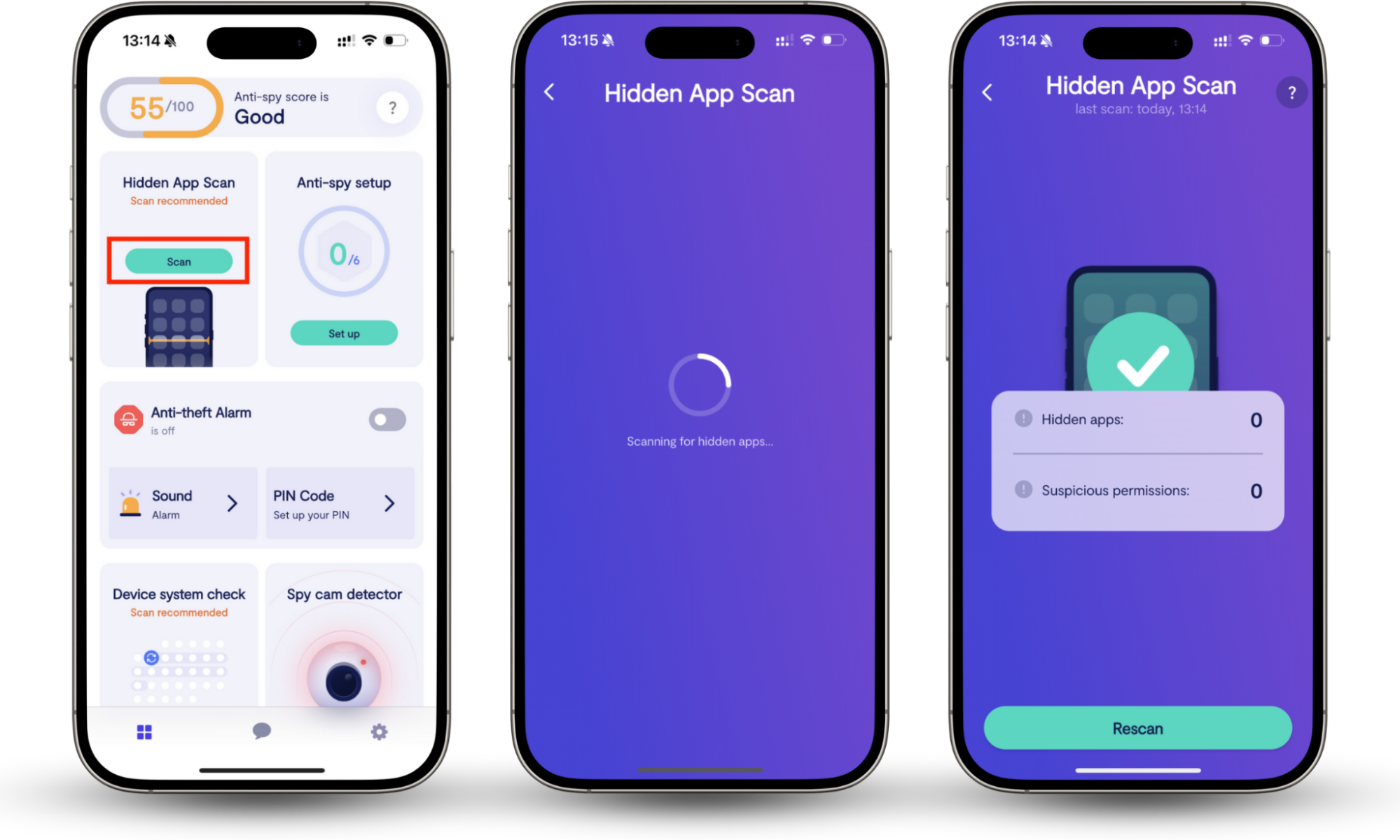
To find and remove suspicious apps from your device, use Clario Anti Spy’s Hidden app scan:
- Open Clario Anti Spy and create a new account.
- Next, look for the Hidden app scan option.
- Press Scan and wait for the app to check your device. If it finds anything strange that you don’t remember installing, remove it immediately.
Conclusion
Voice cloning makes it dangerously easy for scammers to trick you, but you don’t have to be a victim. The best protection is to limit what you share online and establish a family safe word today.
If you’re worried that someone is already listening in or recording your calls, don’t wait to find out. Use Clario Anti Spy’s Hidden app scan to find and remove any spyware that might be stealing your voice or personal data.