Table of contents
- Common tactics used in dating app scams
- 1. Fake or AI-Generated profiles
- 2. Rapid emotional attachment
- 3. Excuses to avoid meeting or video calls
- 4. Moving conversation off app
- 5. Financial emergencies and requests for money
- 6. Inconsistent or vague personal details
- What are common dating app scams?
- 1. Catfishing (fake profiles)
- 2. Crisis scams
- 3. Fake dating sites and bot-driven platforms
- 4. Phishing and identity-theft probing
- 5. Verification code (2FA) scams
- 6. Crypto and “investment” scams
- 7. Gift delivery and customs fee scams
- 8. Inheritance and legal-fee scams
- 9. Money mule recruitment
- 10. Sextortion and intimate-content blackmail
- How to protect yourself from dating app scams?
- What to do if you’ve been scammed on dating app?
- How to report scams on dating apps?
- Conclusion
Common tactics used in dating app scams
Dating app scammers often use the same old tricks. They might create fake profiles using AI-generated photos or stolen social media photos. They often try to move the relationship quickly, declaring their love for you and talking about the future immediately. However, they’ll probably make excuses to avoid meeting up or video calling. Of course, at some point, they’ll usually ask for money, too.
Unfortunately, scammers are everywhere, and some specifically target people looking for romance. They want to get your money, either by asking directly or trying to hack into your social media, email, or online banking accounts. So, you need to protect yourself.
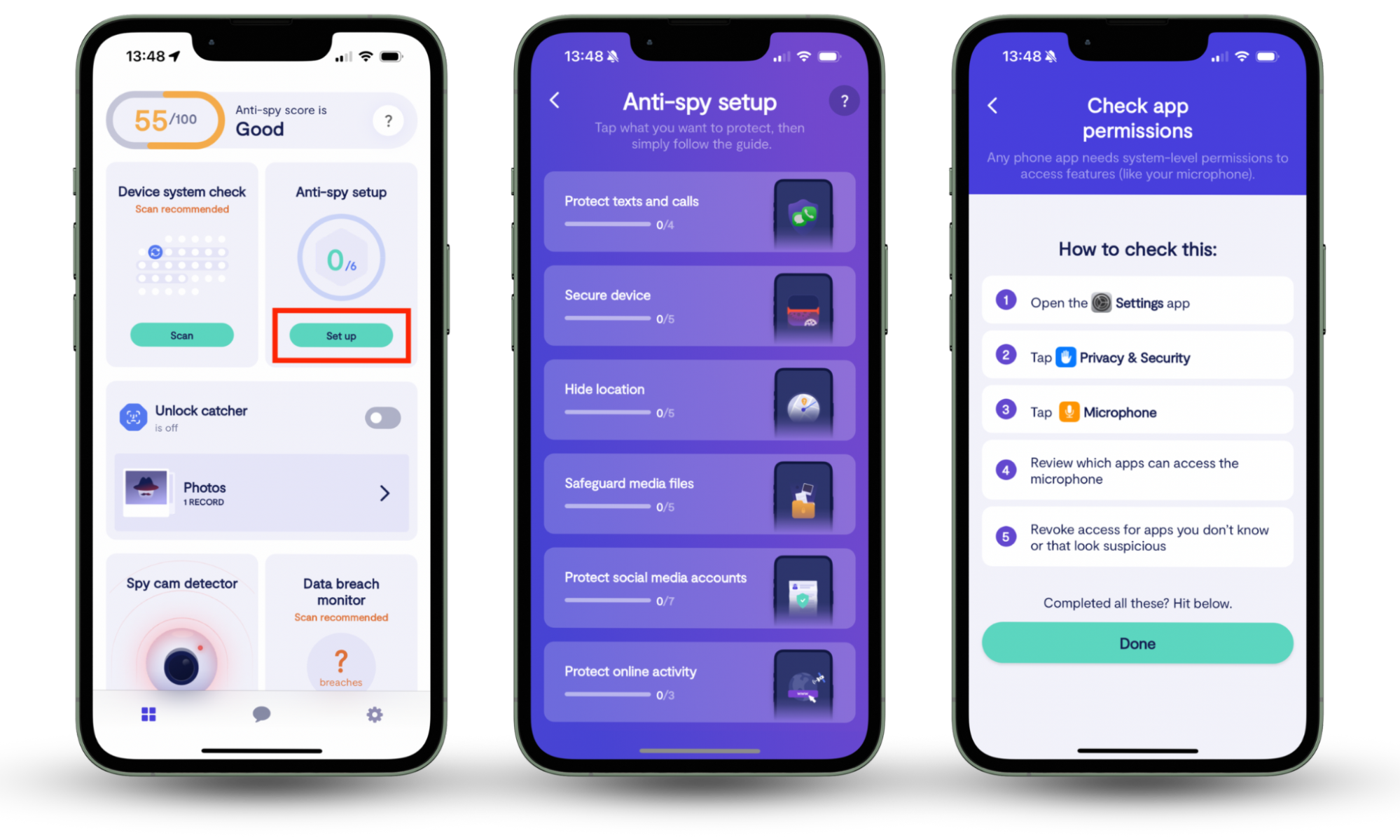
Clario’s Anti-spy setup can help you stay safe. It walks you through a variety of ways to secure your accounts, media files, and your phone in general.
How to improve your phone’s security before you start internet dating:
- Download Clario Anti Spy and set up a subscription.
- Under Anti-spy setup, tap Set up.
- Tap through each section and follow the on-screen guidance. Tap Done when you’ve finished.
Now your device and accounts are safe, let’s look at the tactics used by dating app scammers in more detail.
1. Fake or AI-Generated profiles
Most dating app scammers have fake profiles. They might use AI-generated pictures or steal images from social media.
Many scammers share only a few details on their profiles. For example, they might not have many interests listed because they’ll change their personality and hobbies based on their victim.
Watch out for profiles that look too good to be true, and people who share all of your interests. If your match has model-quality pictures and agrees with you about everything, they might be trying to lure you in so they can scam you.
2. Rapid emotional attachment
Scammers often fall in love quickly. If your match quickly declares their love for you, they might be a scammer. They want you to let your guard down and believe that you’ve found your perfect partner. That way, you’ll be more willing to send money.
This is also known as love bombing. They might constantly message you and talk about their grand plans for the future. They want you to fall for them and feel dependent on them. Learn more about love bombing signs and how to respond.
3. Excuses to avoid meeting or video calls
If you’re talking to a scammer, they’ll probably try to avoid meeting up or using video calls. After all, they don’t want you to know that they’ve used fake pictures.
Dating app scammers might tell you that they can’t do video calls because they’re having technical issues. It’s normal for this to happen occasionally, but if it keeps happening, you should be suspicious.
If someone makes excuses or refuses to meet up with you, there could be another explanation: they might not be interested in you. Either way, it’s best to block them and move on.
4. Moving conversation off app
Dating apps often have a certain level of moderation. They might scan through messages for certain key phrases frequently used by scammers, so fraudsters often want to move the conversation off the app. They might ask to message you through WhatsApp, Signal, Telegram, or other messaging apps.
Be careful if your match asks to start talking through a different app. Remember, apps often have moderation for a reason.
5. Financial emergencies and requests for money
Eventually, most dating app scammers ask for money. They often make up an emergency and tell you that they need cash urgently.
Most cybercriminals will ask for wire transfers, gift cards, or even cryptocurrency. These are all quick ways to transfer money, and they’re nearly impossible to trace or reverse.
Don’t send money to someone you’ve met on a dating app. You won’t get your money back, and you probably won’t hear from them again.
6. Inconsistent or vague personal details
You might notice that your match contradicts themselves sometimes, or seems unsure of what they’re saying. Perhaps they claim to be a native English speaker but make unusual mistakes, for example. They might avoid talking about themselves or refuse to share details like their job, hometown, or age.
Watch out for little inconsistencies. Your match could be lying to you.
What are common dating app scams?
Dating app scammers are rarely original. They usually try the same scams on their victims, like catfishing, faking emergencies, or blackmail.
Common dating app scams include:
- Catfishing (fake profiles)
- Crisis scams
- Fake dating sites
- Phishing scams
- Verification code scams
- Investment scams
- Gift delivery scams
- Legal fee scams
- Money mule recruitment
- Sextortion and blackmail
1. Catfishing (fake profiles)
In catfishing scams, the scammer creates a fake profile. They often use stolen or AI-generated photos and create new identities. They’ll spend weeks or months talking to you and building your trust. However, they’ll avoid meeting up or using video chat.
Catfishing works because dating app scammers play the long game. They build a relationship and gain your trust. When they ask for money, you’ll probably send it. After all, you’ve been talking to this person for ages, and you believe them.
2. Crisis scams
In a crisis scam, your match will gain your trust and then claim to have a sudden emergency. They’ll ask for cash, urgently, and pressure you to send it immediately. However, there’s no real emergency, and the scammer often vanishes as soon as they’ve taken your money.
Crisis scams often work because, as with many types of romance scams, the scammer spends time building up your trust. You believe them, and you’re worried about them.
There’s another reason that crisis scams work, too. The scammer pressures you to act fast. By the time you realize it’s a scam, your money is gone.
3. Fake dating sites and bot-driven platforms
Sometimes, the entire dating site is a scam. You might have to pay to access the site or share personal data, such as your Social Security number. Cybercriminals harvest this information to sell or steal your identity.
Fake dating sites might steal your payment information or track the password and email address you used to sign up. After all, lots of us reuse passwords across accounts, so if they know one of your passwords, they might be able to access others, too.
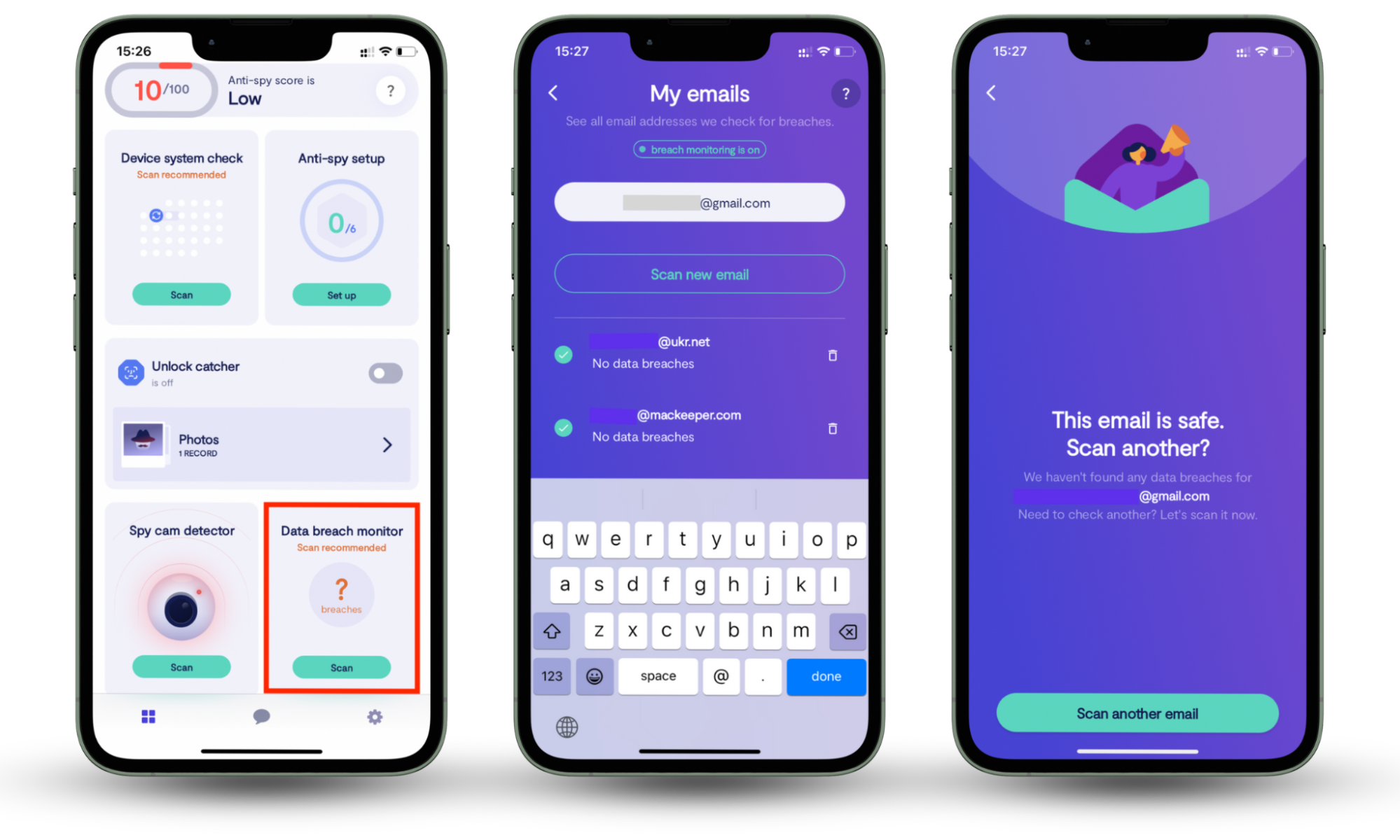
If you think that your passwords, personal details, or accounts have been compromised, Clario Anti Spy’s Data breach monitor can help. The app looks through databases of data breaches and password leaks to check whether your details are included.
Recently, one customer contacted us because he was worried that his personal details might have been exposed. The Clario experts explained how to use the Data breach monitor, and, alarmingly, he found that his social security number and credit card details had been compromised and were circulating on the dark web. Now that he’s aware, he can contact his bank and ensure he’s protected against fraud.
How to check whether your details are involved in data breaches:
- Download Clario Anti Spy and subscribe.
- Under Data breach monitor, tap Scan.
- Follow the on-screen guidance to check whether your personal details have been compromised.
4. Phishing and identity-theft probing
Some scammers ask many questions. These might ask for your first pet's name, your hometown, or your mother’s maiden name, all common questions websites use to reset passwords.
It’s easy to fall for this scam. You think that your match just wants to get to know you. Instead, they’re planning to steal your identity. Be careful what information you share online.
5. Verification code (2FA) scams
In this scam, a hacker convinces you to send them a verification code, so they can gain access to your account, perhaps your email, social media, or even bank account. They might say this is to prove you’re genuine.
They’ll ask you to log in to a certain account, and then share your verification code when it arrives. Rather than proving your identity, this just gives them access to your account.
Never share verification codes with anyone. Your match might make it sound reasonable, but it isn’t. Legitimate apps and websites don’t ask users to share verification codes.
6. Crypto and “investment” scams
Sometimes, a scammer will encourage you to invest in cryptocurrency or other schemes. They’ll gain your trust first, and then advise you to invest. However, you’ll never get your money back.
Investment scammers present themselves as people who are wealthy and successful. They might tell you that you can be just as rich if you follow their advice.
They might ask you to send money directly to them, or tell you which investment platform to use. Perhaps they’ll show you fake documentation that suggests you’re getting amazing returns, but if you try to withdraw that money, they’ll often vanish.
7. Gift delivery and customs fee scams
In a gift delivery or customs fee scam, your match says they’ve sent you a gift, you just need to pay the customs fee or shipping cost to receive it. However, even if you pay, you’ll never receive anything.
It’s easy to fall for this type of scam. After all, if you’ve ordered packages from overseas, you’ve probably come across legitimate customs fees before. It sounds plausible. Unfortunately, it’s a common scam.
Gift delivery scams are similar to sugar daddy scams. In both cases, you’re promised a reward that will never come.
8. Inheritance and legal-fee scams
Some dating app scammers tell you that they’re about to receive a large inheritance. However, they can’t access it until they’ve paid some kind of legal fee, so can you lend them the money? They’ll promise to pay you back, but the money will never materialize.
Inheritance scams work because the scammer has spent time building your trust. They’ve talked about your shared future, and you want to help them. However, there’s no money coming, and no shared future, either.
9. Money mule recruitment
Scammers might ask you to receive money and send it on to someone else, hold crypto, or take money to buy gift cards. They might ask you to do this as a favor, or they might offer to pay you. This is called being a money mule, and the money involved is usually illegally obtained.
Never move money for someone else. Even if you’re not aware that the money is stolen, you can still be prosecuted.
10. Sextortion and intimate-content blackmail
In a sextortion scam, a scammer pushes you to send explicit photos or videos, and then threatens to release them publicly unless you send money. It’s blackmail.
Sextortion often works because you’re embarrassed. You don’t want your nudes to be shared publicly, so you’re willing to pay.
If your match wants nude photos immediately, it can be a red flag of a potential blackmail scam. Find out what to do if you’re a victim of sextortion.
How to protect yourself from dating app scams?
You can protect yourself from scams. Try to spot whether your match is a scammer early in your conversation, and make sure that you don’t share too much information with them.
How to protect yourself from online dating app scams:
- Never send money. They might say it’s an emergency, or that they can help you invest, but in reality, it’s a scam.
- Keep your conversations on the app. Most dating apps have built-in safety features. Scammers want to move the conversation off the app so they can bypass it.
- Insist on a video call before you get too emotionally invested. Dating app scammers often avoid video calls and meetups. Weed out some scammers by insisting on video calls.
- Don’t send intimate photos or videos. Protect yourself from sextortion by refusing to share intimate photos with your matches.
- Don’t share passwords or other private data. Scammers might use this info to access your bank accounts or steal your identity.
- Don’t click on any suspicious links. Scammers might say that they’re sending you a link to a local restaurant, an interesting news article, or their social media page, but it could be a malicious webpage. Some sites will try to install malware on your phone or computer, or harvest your personal information.
- Read reviews before you join any new dating app. To avoid fake dating sites, make sure that you’re using a reputable app like Match, Tinder, Hinge, or eHarmony.
- Use security software to keep your phone and accounts safe. Clario Anti Spy can help you secure your phone and your online accounts, so you can avoid security breaches or take action quickly if you get scammed.
What to do if you’ve been scammed on dating app?
If you’ve been scammed, your priority should be damage control. Make sure that the scammer can’t access your money or accounts. If you’ve already sent money, contact your bank to stop the payments if possible. Change any compromised passwords, too. If you have proof that your match was a scammer, document it, keep copies of emails, and take screenshots of messages. Block the scammer, and don’t engage with them any further.
Don’t feel ashamed or embarrassed. Remember, you’re not alone. More than half of Americans who have used dating apps think they’ve come across scammers.
How to report scams on dating apps?
If someone has scammed you, report them to the app immediately. They can block the user, so they can’t continue to scam others. You should also report it to the FTC. They’ll explain what you should do to protect yourself, and use your report to track patterns and investigate online scams.
How to report a dating app scammer to the FTC:
- Go to ReportFraud.ftc.gov, and click Report Now.
- Complete the report, sharing as much detail as possible.
The FTC will explain the next steps to get your money back and protect yourself. You’re more likely to get your money back if you act fast, so report the scam as soon as possible.
Conclusion
Dating app scammers often create fake profiles, pretend to have emergencies that require urgent cash, or offer to help you invest in crypto schemes. Some fraudsters will even create entire fake sites to harvest your data. Other scammers might try to blackmail you.
To avoid falling for an online dating app scam, try to prove that your match is who they say they are. Ask for video calls, and look out for inconsistencies in their story. Don’t share too much personal information, and never send money to someone on a dating app.
Worried about being scammed when you’re looking for a new relationship? Keep your phone and online accounts safe with Clario Anti Spy.