Table of contents
- 1. Discovering stalkerware
- 2. The downsides of face recognition
- AI bias, facial recognition & accountability
- 3. The black mirror of deepfakes
- 4. Do we need online protection?
- 5. They spy
- 6. The future we want for our children
- 7. Beware of internet trolls
- What most people misunderstand about online privacy
- Conclusion
- Read more:
I’m not famous or influential. Why’d anyone want to spy on me?
If this attitude mirrors your own, then we’ve got some bad news regarding your online security.
Even if you’re an exemplary citizen unconnected to any government or influential company, you’re still at risk of becoming a victim of cybercrime.
We picked the top seven TED talks on privacy to remind you that, no matter how advanced technology gets, there’s always a human element behind them. Discover if you’re being spied on or stalked and the most effective ways to protect yourself.
Expert insight
Why “ordinary people” are valuable targetsModern surveillance rarely focuses on who you are — it focuses on what you generate. Location data, behavioral patterns, private messages, microphone access, and social connections are extremely valuable, even when stripped of names. Cybersecurity researchers consistently report that most real-world spying incidents involve intimate partners, employers, scammers, or data brokers — not high-profile government targets. In other words, anonymity does not equal safety in the digital world.
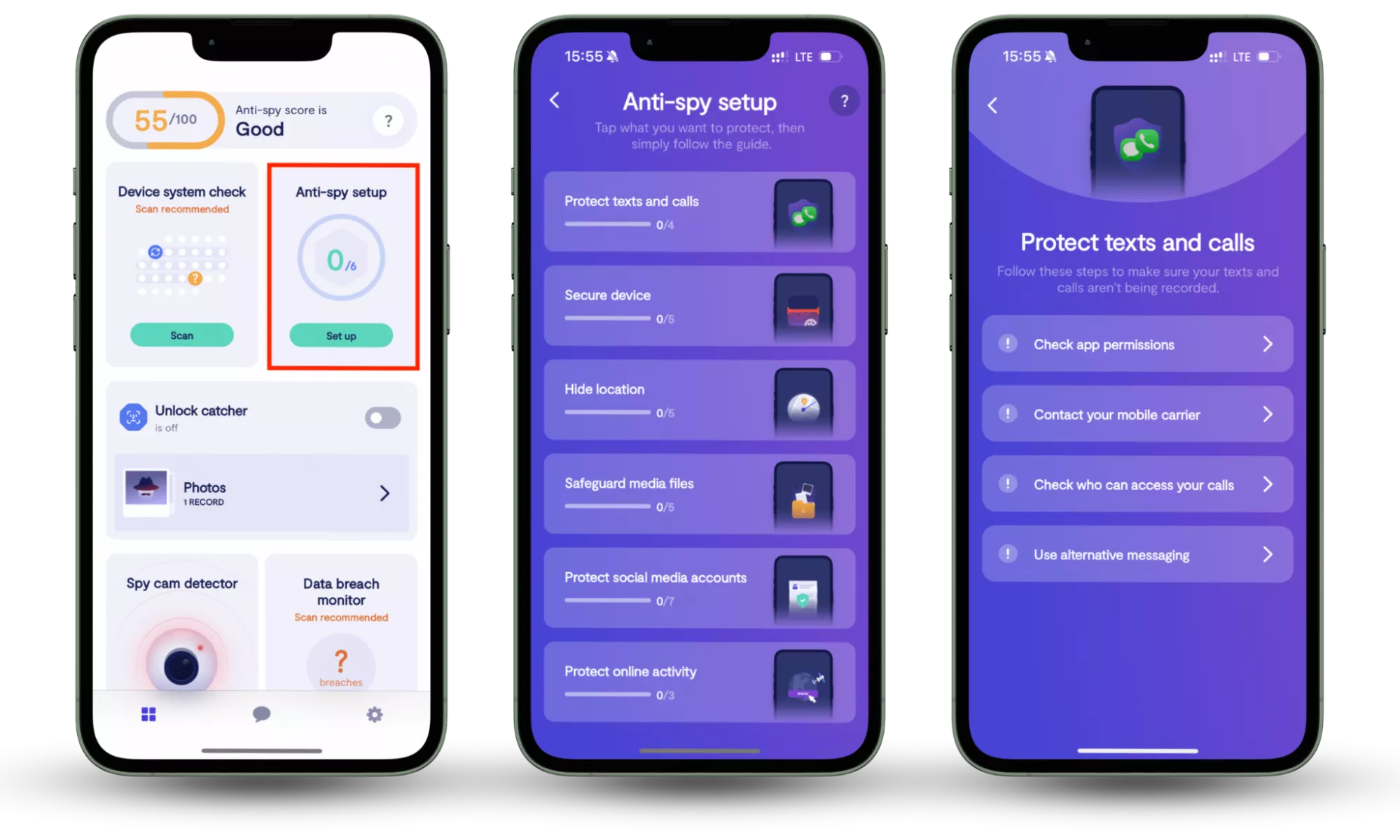
Tools designed to reduce exposure to spyware increasingly focus on prevention rather than detection alone. For example, Clario Anti Spy uses a guided Anti-spy setup that walks users through a practical checklist of essential privacy settings. By reviewing permissions, account access, and system configurations step by step, users can close common gaps that spyware and monitoring tools rely on — especially those that exploit legitimate features rather than malicious code.
Here is how to use Clario Anti Spy’s Anti-Spy setup feature:
- Download Clario Anti Spy, create an account, and sign in.
- Under the Anti-Spy setup section, select Set up.
- Follow the step-by-step guide to identify overly permissive app access, unsecured accounts, and system configurations that are commonly exploited by spyware—strengthening overall protection against malware and covert monitoring.
1. Discovering stalkerware
You may be familiar with the word stalker. But have you heard of stalkerware?
In her recent TED talk, cybersecurity expert Eva Galperin talks about stalkerware - software aimed at spying on people - and reminds us how digital threats go beyond just hackers. If you’ve ever shared your password or account details with a loved one or typed your passcode in public while someone looks over your shoulder, you may be in danger.
What can you do to secure your data and accounts from cybercriminals? What’s stalkerware, and how can it reach your device? Are you safe with an antivirus? And who’s a RAT or Remote Access Trojan? Find out in Eva’s TED talk.
Nota bene
Antivirus software alone often fails to detect stalkerware because many monitoring tools operate using legitimate system permissions rather than exploits. Warning signs frequently include unexplained battery drain, overheating, sudden data usage spikes, or settings changing without user action — especially on smartphones.
2. The downsides of face recognition
Technological advances constantly remind us openness is a myth. In a revealing TED talk, Kate Crockford, a civil rights advocate, asks very important questions: what will happen if technology fails? And whose side will the ethics be on?
Kate talks about face surveillance and why it’s more dangerous to your personal security than you might think.
When a choice arises between ethics and public safety, your fundamental rights are at risk of violation. But privacy should be protected, even if you have nothing to hide.
AI bias, facial recognition & accountability
In a more recent TED talk, computer scientist and digital rights advocate Joy Buolamwini exposes how facial recognition systems often fail the very people they claim to protect. Her research demonstrates how biased training data leads to higher error rates for women and people of color, raising serious concerns about fairness, accountability, and civil liberties. Buolamwini’s work highlights that facial surveillance is not only a privacy issue but also a systemic risk that can reinforce inequality at scale.
3. The black mirror of deepfakes
Now, this TED talk is sure to give you the heebie-jeebies.
You’ve probably used face swap features on FaceApp or those hilarious Instagram masks to put your face on a celebrity or animal. While it’s entertaining, face swaps can lead gullible people into believing in certain things that never happened and words that were never said.
We’re talking about deepfakes, an Artificial Intelligence (or AI) -based technology capable of fabricating video or audio content. And it looks very realistic. The technology has the potential to harm not only our private lives but even national security.
In her TED talk, law professor Danielle Citron explains the details of deepface attacks you may not be ready for.
Explainer
Deepfakes are especially dangerous because they undermine the idea of visual or audio proof. When any image, voice recording, or video can be fabricated convincingly, verifying truth becomes harder for individuals, institutions, and even courts.
4. Do we need online protection?
It’s now time to admit we’re trading our online privacy for the sake of convenience.
No one’s going to pay money for using social networks or search engines. But it’s not money we’re paying with. When we use these services, we voluntarily sign agreements basically stating: “Allow us to spy on you, and you will get free services.”
In this TED talk, data privacy enthusiast Derek Banta makes us realize how much we risk when surfing online and exchanging our data for access to different platforms or websites.
5. They spy
All your devices are exploitable thanks to microphones, cameras, and networks.
Can you imagine how much governments would like to use personal gadgets to spy on citizens? Governments are powerful enough to hack and control your devices. Allegedly, of course. So what stops them?
In this talk, surveillance and cybersecurity counsel Jennifer Granick explains how the issue of confidentiality is hugely underestimated by internet users. Believe us, you need to know what data governments can collect and how they can use it. You’ll be very surprised…
Insight
Surveillance doesn’t require full device control to be effective. Metadata — such as who you communicate with, when, and from where — can reveal more about a person’s life than message content itself.
6. The future we want for our children
Unfortunately, we aren’t born with a built-in knowledge of internet security.
Online threats are lurking in every dark corner of the web, and our kids might not be aware of them. But are the parents? By exposing their children’s lives on social media, parents put their offspring in dangers they’re unable to completely comprehend.
In this TED talk, sociologist Veronica Barassi highlights the types of data gathered about our kids and how it can influence (or even ruin) their future.
7. Beware of internet trolls
Trolls are real. Not the large ones who live under bridges and fight witchers, of course, but internet trolls. They are flourishing and make people on the internet feel miserable, scared, or furious. The web is full of aggressive verbal bullies, blackmailers, and individuals who like to spread chaos online just for fun (or even for money).
In this TED talk, charismatic journalist Andrew Marantz talks about (and with) the people who stand against the internet wars, hoaxes, fake news, and other dreadful things we may encounter when surfing the world wide web.
What most people misunderstand about online privacy
Digital surveillance today is less about watching individuals and more about predicting behavior. Your data doesn’t need to be reviewed by a human to affect your life — automated systems can infer preferences, vulnerabilities, and future actions at scale.
Conclusion
An antivirus is no longer enough to completely protect yourself from cyberthreats. The dark web markets are highly responsive to global trends. The very concept of fake news has evolved. And this is truly disturbing.
This shift is why modern digital protection increasingly focuses on reducing exposure rather than relying on antivirus software alone. Solutions like Clario Anti Spy emphasize proactive privacy hygiene through features such as an Anti-spy setup — a guided checklist that helps users review app permissions, account access, and device configurations. By addressing common weak points before they’re exploited, this approach helps limit how spyware, monitoring tools, and data-harvesting services gain a foothold in everyday digital life.
But the internet is not to blame. It always is - and always has been - about the people living online and using it for their own (sometimes devious) ends. So next time you post about the fun time you and your (tagged) friends had, with geotags, of course, think if your virtual popularity is worth it.
And if you’d like to discover more about how living in the digital realms can exploit you and your data, we have some excellent selections of books and movies for you to get into.